
What Size Cable Do I Need? A Practical Guide to DC Cable Sizing
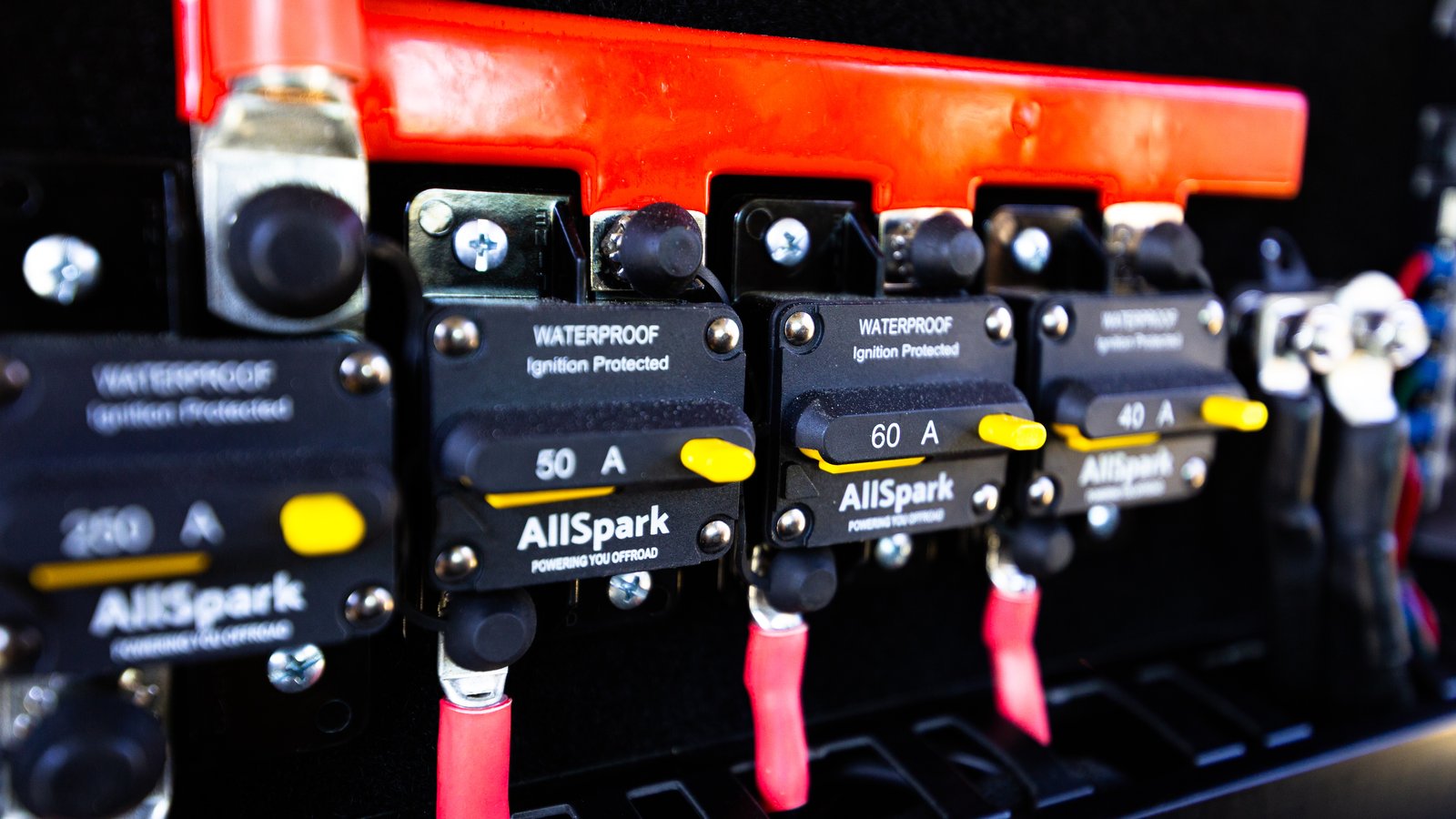
Two of the most common questions we get asked are "what size cable do I need?" and "what size fuse or circuit breaker do I need to protect it?" - and these are arguably the most important components to get right. Undersized cable is not only a leading cause of voltage drop, inverter shutdowns and inefficient charging, but, in the worst cases, it can cause overheating that can become a genuine fire risk in your caravan or 4WD.
The tricky part is that cable sizing isn't one-size-fits-all. The right cable depends on your system voltage, the current draw of your load, and how far the cable needs to run. Whether you're wiring a 12V battery to an inverter, running cable from a solar panel to an MPPT controller, or connecting a DC-DC charger, the same principles apply. Get any one of those wrong and you'll end up with a system that (at best) underperforms, or (worse) one that's potentially very dangerous.
This guide walks you through how we size cable & circuit protection for both battery and solar circuits, the common mistakes we see every week, and how to use our free cable sizing calculator to get our recommendation for your setup.
KEY TAKEAWAYS
- ⚡ Cable sizing depends on three things: current draw, cable length, and acceptable voltage drop
- ⚡ Voltage drop is the hidden killer: A cable might handle the amps safely but lose so much voltage over its length that your inverter shuts down or your fridge runs inefficiently
- ⚡ The fuse protects the cable, not the load: Your circuit protection must be rated below the cable's ampacity - if the fuse is bigger than what the cable can handle, it won't trip before the cable overheats
- ⚡ Solar cables need sizing too: Long roof-to-controller runs result in power lost due to voltage drop - use the panel's short circuit current (Isc) and voltage at max power (Vmp) to size correctly
- ⚡ Use our Cable Size & Circuit Protection Calculator to get our recommendation for your specific setup in seconds
Quick Reference: Inverter Cable and Fuse Sizing
If you just want a quick answer for a typical inverter installation on a 12V system with a cable run of 1–2 metres, here's what you need:
| Inverter Size (12V) | 1000W | 1500W | 2000W | 2500W | 3000W |
| Specifications | |||||
| Max Current (A) | 100 | 150 | 200 | 250 | 300 |
| Recommended Cable | 4 B&S (20.26mm²) | 2 B&S (32mm²) | 0 B&S (49mm²) | 00 B&S (64mm²) | 000 B&S (83mm²) |
| Recommended Circuit Breaker | 100A | 150A | 200A | 250A | 300A |
We recommend AllSpark Circuit breakers over fuses for inverter installations
| Specifications | |
| Max Current | 100A |
| Recommended Cable | 4 B&S (20.26mm²) |
| Recommended Fuse | 100A |
| Specifications | |
| Max Current | 150A |
| Recommended Cable | 2 B&S (32mm²) |
| Recommended Fuse | 150A |
| Specifications | |
| Max Current | 200A |
| Recommended Cable | 0 B&S (49mm²) |
| Recommended Fuse | 200A |
| Specifications | |
| Max Current | 250A |
| Recommended Cable | 00 B&S (64mm²) |
| Recommended Fuse | 250A |
| Specifications | |
| Max Current | 300A |
| Recommended Cable | 000 B&S (83mm²) |
| Recommended Fuse | 300A |
Why Does Cable Size Matter So Much?
In a 12V DC system, current is high relative to voltage. A 2000W inverter on 12V draws around 200A - that's serious current flowing through your cables. Compare that to a 240V household circuit where the same 2000W only draws about 8A.
Because the current is so high, even small amounts of resistance in the cable cause measurable voltage drop. And voltage drop means three things:
1. Lost power: Every volt you lose in the cable is energy lost as heat. On a 12V system running at 200A, a 0.5V drop means 100W of wasted power - just heating up your wiring.
2. Equipment problems: Inverters, MPPT controllers, and DC-DC chargers all have low-voltage cutoffs. If your battery is sitting at 12.4V but 0.8V is lost in the cable, the inverter sees 11.6V and may shut down, even though the battery is fine.
3. Fire risk: A cable running above its rated current generates heat. If it can't dissipate that heat fast enough (especially when bundled with other cables or run through conduit), insulation can soften, melt, and ultimately cause a fire. In a caravan or vehicle where you're sleeping, this isn't theoretical, it's a well documented cause of incidents.
The Two Tests Every Cable Must Pass
A lot of people think cable sizing is just about amps - "can this cable handle the current without melting?", but that's only half the story. Every cable in your system needs to pass two separate tests:
Test 1: Ampacity (Current Carrying Capacity)
The cable must be rated to carry at least as much current as the fuse or circuit breaker protecting it. Remember - the fuse protects the cable, not the device. If your circuit has a 200A fuse, the cable must be rated above 200A, otherwise the cable overheats before the fuse blows.
This is where we see a common mistake: people size the fuse to the load and then pick a cable that just handles the load current. But a fuse rated at the exact load current will nuisance-trip, so the fuse ends up being the next standard size above - and now it's higher than the cable's rating. The cable needs to handle the fuse size, not the load.
Test 2: Voltage Drop
Even if a cable passes the amperage test, it might still cause too much voltage drop over its run length. This is especially critical on longer cable runs - a cable size that works perfectly at 1 metre may cause unacceptable voltage drop at 3 metres.
Voltage drop is calculated using:
Vdrop = I × (ρ ÷ A) × L
Where:
- I = max load current in amps
- ρ = resistivity of copper (0.01724 Ω·mm²/m at 20°C)
- A = cross-sectional area of the cable in mm²
- L = total cable length (round trip - so double the one-way distance)
For most 12V installations, you want voltage drop under 3% (that's 0.36V on a 12V system). Some critical applications may require tighter limits.
What Size Cable for a 2500W Inverter? (Worked Example)
Let's walk through a real scenario - one of the most demanding setups we see.
The setup: AllSpark 2500W Pure Sine Wave Inverter on a 12V system, with a 2-metre cable run from battery to inverter.
Step 1 - Work out the current. A 2500W inverter can draw up to 2750W from the battery (taking into account inverter efficiency losses). At worst-case battery voltage of around 10V under load, that's 250A. We use a simplified formula: watts ÷ 10 for 12V systems, which accounts for efficiency loss and battery sag. So: 2500 ÷ 10 = 250A.
Step 2 - Select the fuse or circuit breaker. For inverter circuits, matching the fuse to the calculated current is acceptable, so we would recommend an AllSpark 250A Circuit Breaker. The reason we recommend circuit breakers (and ours specifically, not unreliable Temu specials), is so that if an overload does occur, the breaker will trip, and be able to be re-set easily, rather than trying to search for a replacement fuse at the (not so local) roadhouse (our AllSpark Circuit Breakers are also able to withstand the surge power from inverters without tripping immediately). Now remember, the cable must be rated above this.
Step 3 - Check ampacity. Looking at our cable data (based on Tycab single core ratings), 00 B&S (64.15mm²) is rated for 292A, which is above the 250A Circuit Breaker.
Step 4 - Check voltage drop. Using the formula with max load current (250A), a 2m one-way run (4m round trip), and 64.15mm² cable:
Vdrop = 250 × (0.01724 ÷ 64.15) × 4 = 0.269V (2.24% of 12V) - passes at 3%.
Result: 00 B&S (64.15mm²) cable with a 250A Circuit Breaker.
If the cable run was longer - say 3 metres one way - the voltage drop rises to 0.403V (3.36%), which exceeds 3%. In that case, you'd need to run double 0 B&S cables in parallel to bring the effective cross-section up.
Common Cable Sizing Mistakes We See Every Week
1. Using the cables that came in the box (or the one the salesman sold you in a "kit"): Generic or rebadged import inverters are frequently sold with cables that are dangerously undersized for the inverter's rated output. We hear it regularly: "The cables they supplied are a joke." If you're installing an inverter rated at 2000W or above, assume the included cables need replacing unless the manufacturer specifically states the gauge and it matches your installation length.
2. Ignoring cable length: A cable size that's perfectly adequate at 0.5m may cause excessive voltage drop at 2m. Every metre of cable adds resistance, and remember, it's a round trip. A 2m run is actually 4m of cable the current has to travel through.
3. Sizing the fuse to the load instead of the cable: The fuse is there to protect the cable. If your cable is rated at 210A and you fit a 250A fuse because that's closer to your load current, the cable can overheat before the fuse blows. Always ensure your fuse rating is below the cable's ampacity rating.
4. Not accounting for inverter efficiency: A 2000W inverter doesn't draw 2000W from the battery - it draws more, because the inverter itself consumes power during the conversion from DC to AC. On a 12V system, a good rule of thumb is to divide the inverter's wattage by 10 (not by 12) to get the expected current draw. This accounts for typical efficiency losses and battery voltage sag under load.
5. Running cables through conduit without derating: A cable's published ampacity rating assumes it can dissipate heat to the surrounding air. Bundle multiple cables together or run them through conduit and that heat has nowhere to go. In these situations, you need to derate - which typically means going up a cable size.
B&S Gauge vs Metric - Cable Size Conversion Chart
In Australia we use the B&S (Brown & Sharpe) gauge system for larger cables, alongside metric cross-sectional area in mm². Smaller automotive cables are sold by their conductor diameter (2mm, 3mm, etc.). Here's how they relate:
| Cable | Cross Section (mm²) | Single Core Ampacity | Common Uses |
| Automotive Cable | |||
| 2mm Auto | 0.56 | 10A | Small LED accessories |
| 3mm Auto | 1.13 | 20A | LED strips, small loads |
| 4mm Auto | 1.84 | 28A | Moderate accessories |
| 6mm Auto | 4.59 | 48A | Compressors, fridges (short runs) |
| B&S Gauge Cable | |||
| 8 B&S | 7.71 | 74A | LED bars, compressors, fridges |
| 6 B&S | 13.5 | 103A | Fridges, moderate DC loads |
| 4 B&S | 20.26 | 135A | DC-DC chargers, larger loads |
| 2 B&S | 32.07 | 188A | Small inverters (up to ~1500W @ 12V) |
| 0 B&S (1/0) | 49.0 | 246A | 2000W inverters (short runs) |
| 00 B&S (2/0) | 64.15 | 292A | 2000W–2500W inverters |
| 000 B&S (3/0) | 83.19 | 335A | 3000W inverters |
| Specifications | |
| Cross Section | 0.56mm² |
| Single Core Ampacity | 10A |
| Common Uses | Small LED accessories |
| Specifications | |
| Cross Section | 1.13mm² |
| Single Core Ampacity | 20A |
| Common Uses | LED strips, small loads |
| Specifications | |
| Cross Section | 1.84mm² |
| Single Core Ampacity | 28A |
| Common Uses | Moderate accessories |
| Specifications | |
| Cross Section | 4.59mm² |
| Single Core Ampacity | 48A |
| Common Uses | Compressors, fridges (short runs) |
| Specifications | |
| Cross Section | 7.71mm² |
| Single Core Ampacity | 74A |
| Common Uses | LED bars, compressors, fridges |
| Specifications | |
| Cross Section | 13.5mm² |
| Single Core Ampacity | 103A |
| Common Uses | Fridges, moderate DC loads |
| Specifications | |
| Cross Section | 20.26mm² |
| Single Core Ampacity | 135A |
| Common Uses | DC-DC chargers, larger loads |
| Specifications | |
| Cross Section | 32.07mm² |
| Single Core Ampacity | 188A |
| Common Uses | Small inverters (up to ~1500W @ 12V) |
| Specifications | |
| Cross Section | 49.0mm² |
| Single Core Ampacity | 246A |
| Common Uses | 2000W inverters (short runs) |
| Specifications | |
| Cross Section | 64.15mm² |
| Single Core Ampacity | 292A |
| Common Uses | 2000W–2500W inverters |
| Specifications | |
| Cross Section | 83.19mm² |
| Single Core Ampacity | 335A |
| Common Uses | 3000W inverters |
How to Size Cable for Solar Panels
Solar cable sizing follows the same two tests - ampacity and voltage drop - but the inputs are different to battery circuits. Instead of working from an inverter's wattage or a load's amp draw, you're working from the solar panel's specifications.
What current to use for solar cable sizing
Use the panel's short circuit current (Isc), not its operating current (Imp). Isc is the worst-case current the panel can produce, and it's the figure your fuse and cable need to handle. You'll find it on the panel's datasheet or on the label on the back.
For a single panel, the cable and fuse only need to handle that one panel's Isc. For panels wired in parallel, add the Isc of each panel together - that's the total current the cable between the panel's branch connection and the controller needs to carry.
Panels wired in series don't increase current (they increase voltage instead), so the cable only needs to handle the Isc of one panel.
What voltage to use for solar cable sizing
In our Cable Size & Circuit Protection Calculator, select "DC load (amps)" mode and enter the panel's Isc as the load current. For voltage, select the option closest to your panel's voltage at maximum power (Vmp). Common examples (using AllSpark Glass Solar Panels):
- A single 100W panel has a Vmp of 20.5V - select 18V
- Two 170W panels in series - Vmp of 2 x 18.6V - select 36V
- A single 24V 135W panel - Vmp of 41V - select 36V
- Three 200W panels in series (20.5V Vmp each) - select 60V
- Two 24V 200W panels in series - Vmp of 2 x 41V - select 72V
Why voltage drop matters more for solar
Solar panels are often mounted on the roof of a caravan, which means cable runs of 5-8 metres or more from the panels to the MPPT controller. At these lengths, voltage drop can significantly effect your charging performance. Every volt lost in the cable is a volt your MPPT controller can't use. Keeping voltage drop under 3% is especially important for solar circuits - tighter limits (1-2%) are even better if the cable size allows it.
DC-DC charger cable sizing
When sizing input cables for a DC-DC charger, the input current is higher than the output charge current because the charger steps voltage down (from vehicle alternator voltage to battery charging voltage). As a rule of thumb, increase the input load current by 10% compared to the output charge current when using the calculator.
Use Our Free Cable Sizing Calculator
Rather than running the maths yourself, use our Cable Size & Circuit Protection Calculator. Enter your inverter wattage (or DC load current for solar and other circuits), voltage, and cable run length - it'll recommend a cable size, circuit breaker/fuse rating, and show you the expected voltage drop.
The calculator checks both ampacity and voltage drop, and shows you a comparison table so you can see exactly why certain cable sizes pass or fail for your setup.
If you want further information on how circuit breakers and fuses work with cable sizing - including placement rules, busbar configurations, and solar panel fusing - see our guide: What Size Circuit Breaker and Cable?
If you're not sure what size inverter you need, start with that article first - once you know the inverter wattage, you can come back here to size the cable.
The Bottom Line
Getting cable sizing right isn't complicated once you understand the "why", but it's not something to guess at (or trust the salesman even!). The consequences of undersized cable range from annoying (inverter shutdowns, voltage drop) to dangerous (overheated wiring, fire risk), so it's worth ensuring you understand what's going on if you're attempting to do an installation yourself.
If you're planning an install or upgrading your system and want to make sure your cabling is up to the job, start with our cable sizing calculator and browse our range of cables, circuit breakers, and fuses. Or if you'd prefer to talk it through, get in touch with the team - we deal with these questions every day.
***The information provided here is general in nature. If you aren't confident with installing 12V (or 24V or 48V) systems, you should always seek the help of a professional, qualified and knowledgeable auto-electrician.***