
Off-Grid Battery and Solar Calculator
Know your daily power usage but not how much battery and solar to buy? The System Sizer balances both against your trip length, reserve target, and expected sun.
KEY TAKEAWAYS
- ⚡ Battery is sized to two days of daily usage at 80% efficiency ((2 × daily Ah) ÷ 0.8, rounded up to the nearest 50 Ah). This gives real-world buffer for a single bad-weather day, slide up for more headroom
- ⚡ Solar is sized to fill the gap between your total trip consumption and what the battery covers, so the bank ends at your reserve % when you pack up. For very short trips (1–2 days), the battery alone can carry the load and no solar is required
- ⚡ Reserve % is your DCDC lever: driving every second day, slide it to 10%; remote with no recharge, keep it at 20% or higher
- ⚡ Numbers are estimates, not guarantees: a battery monitor is the only way to measure actual consumption once your system is installed
- ⚡ Need your daily Ah figure first? Use the Daily Power Usage Calculator then drop the result into the System Sizer below
Calculate the solar and battery you need for your trip. Outputs based on stationary days (no driving, therefore no DCDC charging).
Adjust the sliders to match your usage and conditions. System efficiency is fixed at 80%. All figures are estimates, a battery monitor is the best way to measure actual consumption once your system is installed.
Your Scenario
Set your daily usage, trip length, reserve target, and expected peak sun hours.
Adjust Your Setup
Move either slider, the other adjusts to keep the system balanced.
Battery Bank
—
Ah LiFePO4
Solar Panels
—
watts
500Ah is the minimum recommended battery bank size for your daily usage entered. Slide up for more headroom on bad-weather days, we do not recommend going below this value.
How to use the System Sizer
The calculator works in three steps. The first slider is your daily power usage in amp hours. The next three describe your trip and conditions. The last two let you adjust battery and solar by hand once you can see the recommended setup.
Step 1: Get your daily power usage
If you do not already know it, run your appliance list through the Daily Power Usage Calculator. It returns a single number in amp hours per day. Drop that figure into the first slider.
Step 2: Set your trip and conditions
Pick how many days you will be stationary (no driving, no DCDC top-up), the reserve percentage you want left in the battery at the end of the trip, and the peak sun hours you expect. Peak sun hours vary by location and season: 4.5 is a sensible mainland Australian average, drop to 3 in winter or wet weather, push to 6 in summer at low latitudes.
Step 3: Adjust the balance
The calculator gives you a balanced recommendation by default. The battery is buffered to two days of usage; solar is sized to fill the trip's gap. Use the bottom two sliders to bias the system. More battery means quieter operation, fewer panels and a bigger buffer for overcast days. More solar means a lighter battery bank but more vulnerability to bad weather. The numbers update live so you can see the trade-off.
How the System Sizer calculates your numbers
This is how we typically size off-grid systems at Offroad Living. Other approaches exist, solar engineers and component manufacturers use their own efficiency assumptions and formulas, and there are always exceptions and personal circumstance that can change the advice given. We have used these numbers across hundreds of caravan, 4WD and marine setups, and they consistently give Australian customers a reliable starting point. Treat the output as a well-grounded estimate, then refine with a battery monitor once your system is installed.
Every figure on the page comes from a single set of formulas. The battery is sized to a two-day buffer at 80% efficiency. Solar fills the gap so the trip ends at least at your reserve %.
Daily solar yield in amp hours = panel watts × peak sun hours ÷ 12V × 80% efficiency.
Minimum battery bank = (2 × daily usage Ah) ÷ 80% efficiency, rounded up to the nearest 50 Ah. This is the floor we recommend regardless of trip length. The 2-day buffer protects you from a single bad-weather day without forcing the battery to deep cycle.
Solar panel size = (total trip consumption − battery's usable capacity) ÷ (trip days × 80% efficiency × peak sun hours ÷ 12V), rounded up to the nearest 50 W. The maths sizes solar to land the battery at least at your reserve % when you pack up. If the battery alone can carry the whole trip (typical for 1–2 day stationary windows), solar drops to zero - some short-trip setups genuinely need no solar at all.
The 80% efficiency figure accounts for real losses you cannot avoid: cable resistance, MPPT controller losses, lithium chemistry round-trip losses, inverter standby draw, and panel temperature derating in summer heat. Premium components push this above 85%, but planning at 80% gives you a safety margin so the first dust storm or string of overcast days does not flatten the bank.
The calculator assumes worst case: stationary days only, no driving, no DCDC top-up. If you drive every second day, your DCDC charger does some of the work the solar would otherwise have to do, and you can drop the reserve slider to 10% to model that. The default battery is buffered to two days of usage, but a long string of overcast days can still push you below reserve. For long trips, shaded sites, or genuinely bad-weather seasons, push the battery slider up by another 50 to 100 Ah for extra headroom.
Worked examples
Three real-world setups, three different answers. Use these as anchors and adjust from there.
Example 1: 7-day touring caravan, mainland summer
A family caravan running a 12V fridge, lights, water pump, charging two phones and a tablet, plus an evening of TV. Daily usage: 190 Ah. Off-grid for a week with no driving recharge. Reserve target: 20%. Peak sun hours: 4.5.
Recommended setup: 500 Ah lithium bank, 450 W of solar. The 500 Ah battery is sized for two days of usage at 80% efficiency, giving real buffer for any single bad-weather day. The 450 W of solar generates around 135 Ah on a 4.5-hour sun day, fills the trip's deficit and lands the bank at the min 20% reserve when you pack up. For long stays in shaded camps or wet weather, push the battery slider up further.
Example 2: 4WD weekend trip, two stationary days, autumn
A solo or two-person 4WD setup with a fridge, LED camp lights, and laptop charging. Daily usage: 90 Ah. Two days stationary at the camp site, driving back the third day. Reserve target: 10% (DCDC will top up on the drive home). Peak sun hours: 3.5.
Recommended setup: 250 Ah lithium bank, no solar required. With only two stationary days and a 250 Ah bank sized for two days of usage at 80% efficiency, the battery carries the entire trip on its own. Drive home, let the DCDC refill the battery, no panels needed. If you would still like daytime solar to keep the battery topped up while parked (or you stay out longer than two days), slide the solar slider up - 200 W will keep the bank trickled across stationary days.
Example 3: Liveaboard fishing boat, 14 days, mid-winter
A liveaboard with fridge, freezer, marine electronics on standby, lights, water pump, and inverter loads for a small espresso machine. Daily usage: 140 Ah. Two weeks at anchor, no engine charging. Reserve target: 30% (long trip, no rescue). Peak sun hours: 3.
Recommended setup: 350 Ah lithium bank, 650 W of solar. The 350 Ah battery is sized for two days of usage at 80% efficiency, giving real buffer through a winter overcast string. The 650 W of solar generates around 130 Ah/day at 3 hours of winter sun, fills the trip's deficit, and lands the bank at the 30% reserve. For a long winter trip with no rescue, this is a sensible starting point. Push the battery slider higher (400 Ah+) if you want even more reserve buffer.
Common mistakes when sizing an off-grid system
The four mistakes we see most often, and how to avoid each one.
Underestimating the fridge
A 12V fridge in 35 degree summer heat draws roughly double what the manufacturer rates it at in 25 degree conditions. If you are sizing for an Australian summer, do not trust the brochure number. Measure with a battery monitor for a week, or assume worst case.
Forgetting that solar drops in winter and rain
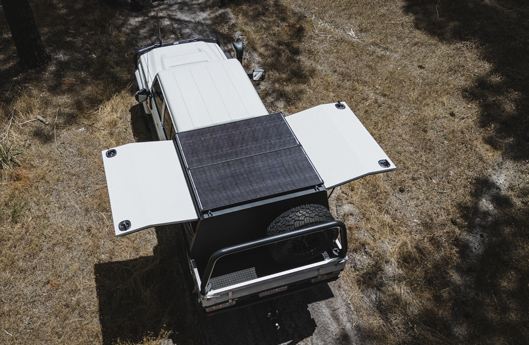
Peak sun hours is a daily average. A clear summer day at low latitude might give you 6 hours, a wet winter week in Tasmania might give you 1.5. The calculator defaults to 4.5 because that is a reasonable mainland average, but if your trip is genuinely winter or genuinely cloudy, drop it. Because of this, folding solar panels can be a great addition to winter as you can "chase the sun" and have them angled to optimise energy capture.
Sizing the battery for a perfect day instead of a worst case
Your battery is your protection against the days the solar does not deliver. The calculator's default 2-day battery buffer handles a single bad day, but a long string of overcast days can still flatten the bank. For long trips in genuinely bad-weather seasons, push the battery slider up by another 50 to 100 Ah for extra buffer. The reserve % slider is your other lever: keep it at 20% or higher unless you are confident a DCDC top-up is coming.
Battery vs solar: how the calculator balances them
The default recommendation is a balanced setup with the battery buffered to two days of usage. The two bottom sliders let you bias the system either way without breaking the maths. Each direction has trade-offs.
More battery, less solar. Fewer panels to mount, less roof real estate consumed, less internal space occupied by portable panels, and a buffer against overcast days. Better for shaded camps, dense tree cover, or rigs where roof space is tight. Downside: heavier, more expensive battery bank, and longer recovery time after a flat.
More solar, less battery. Lighter battery bank, faster recharge in the sun, cheaper if you have the roof/storage space. Better for open country, beach camps, and anywhere with reliable sun. Downside: a string of overcast days will flatten the smaller battery faster, and you need somewhere to put the panels.
For most touring setups, the default balanced recommendation is a good starting point. If you have specific constraints (no roof space, lots of shade, very long trips), use the sliders to bias the system in the direction that suits.
Shop the setup
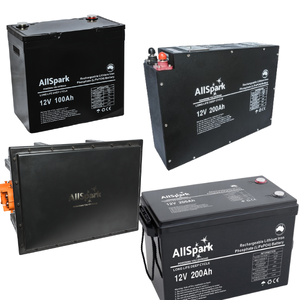
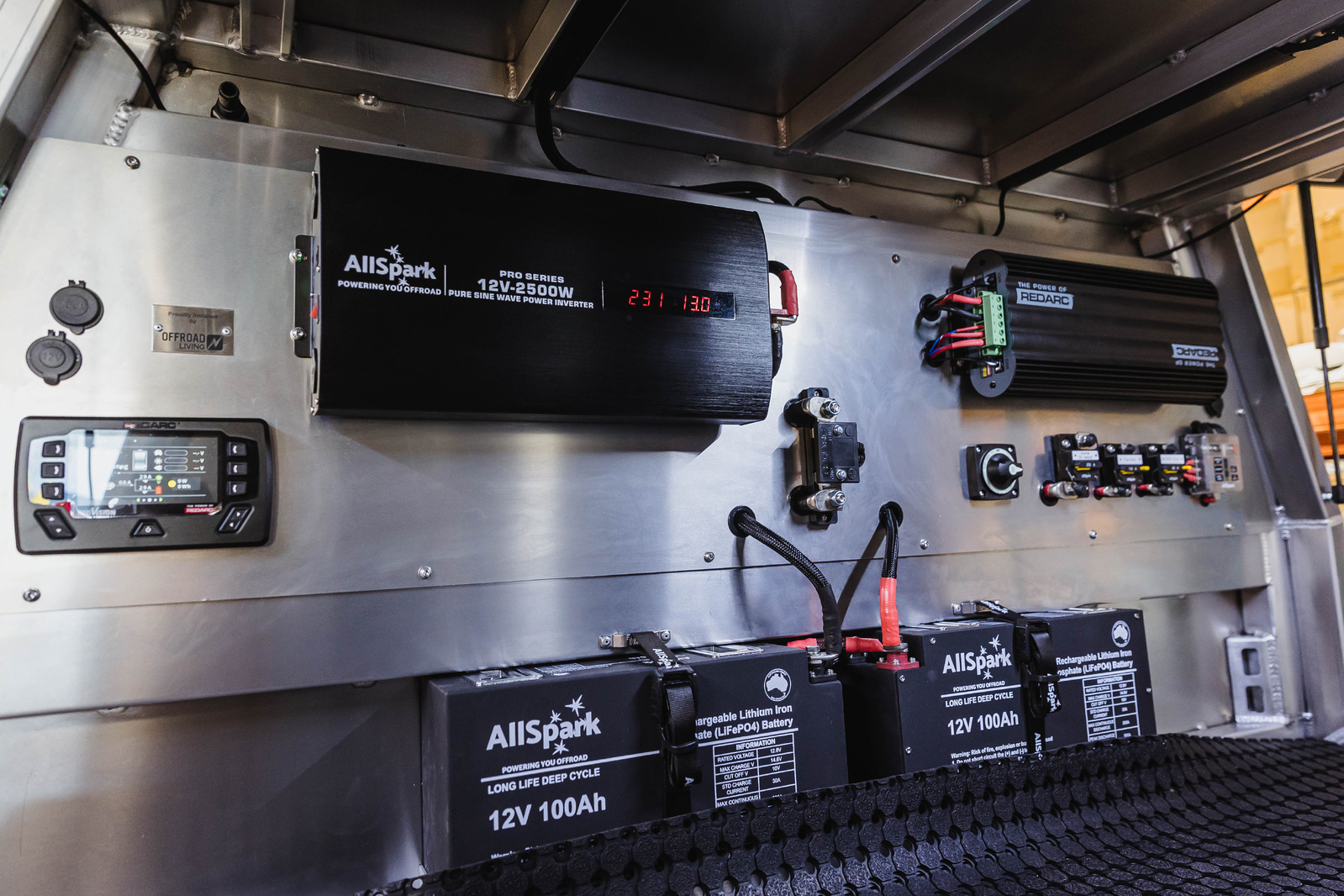
Once you have your numbers, browse the categories below. If you would rather skip the install work, the AllSpark Grid range is a pre-built off-grid system with battery, inverter, and DCDC charging in a single integrated package.
Frequently Asked Questions
Q: How much battery and solar do I need for a caravan?
A: It depends on three things: how much you use per day, how long between drives, and where you are camping. The System Sizer above gives you a starting number in seconds. Most touring caravans landing on this page end up between 400 and 700 Ah of lithium, paired with 350 to 650 W of solar. The battery is sized for a 2-day buffer at 80% efficiency, the solar fills the gap across the trip.
Q: What size lithium battery do I need for off-grid camping?
A: The minimum we recommend is around 2.5 times your daily Ah usage (2 days of usage at 80% efficiency, rounded up to the nearest 50 Ah). The 2-day buffer protects you against a single bad-weather day. For trips longer than a few days, in shoulder seasons, or in shaded camps, push higher. The System Sizer above starts at this minimum and lets you slide the battery up for more headroom.
Q: How much solar do I need to keep my battery topped up?
A: If you want solar to fully cover your daily draw without touching the battery, the rule of thumb is daily Ah × 12 ÷ peak sun hours ÷ 0.8 system losses. Example: 190 Ah/day with 4.5 PSH needs about 633 W (round to 650 W) to break even on a typical sun day. The System Sizer takes a more efficient approach: it sizes solar to fill the gap between total trip consumption and what the battery can supply, which usually needs less solar. For very short stationary trips (1–2 days), the battery alone can carry the load and no solar is required at all.
Q: Why does the calculator assume 80% system efficiency?
A: Real-world losses from cables, MPPT controllers, battery chemistry round-trip, inverter standby and panel temperature derating add up. 80% is a conservative figure that protects you from undersizing. Premium components (good MPPT, properly sized cabling, lithium chemistry) can push this above 85%, but planning at 80% gives you a safety margin.
Q: What is "reserve at end of trip" and what should I set it to?
A: It is how full you want the battery to be when the trip ends. 20% is a sensible default. If you are driving home the next day and your DCDC charger will refill the battery on the road, or you have an ACDC charger, slide it down to 10%. If you are remote with no driving recharge, or a short drive in between camping spots, keep it higher.
Q: Do I need to factor in DCDC charging on driving days?
A: The calculator assumes stationary days only, worst case, no driving. If you drive a decent amount every second day and have a DCDC charger like the REDARC Alpha 50 (used in the AllSpark Grid range), drop the reserve slider down to 10% to model that recharge. The DCDC tops you up while you drive.
Ready to size your setup?
Scroll back to the System Sizer at the top of this page and run your numbers. If you do not have your daily Ah figure yet, start with the Daily Power Usage Calculator. Stuck on a specific scenario? Drop us a line and we will help you spec the right system for your rig.